Frugal capex, staged in tiers
Where a mega-refinery demands colossal capital in one go, the modular model invests train by train: you pay for capacity at the pace demand justifies. No oversizing, no asset frozen in concrete.
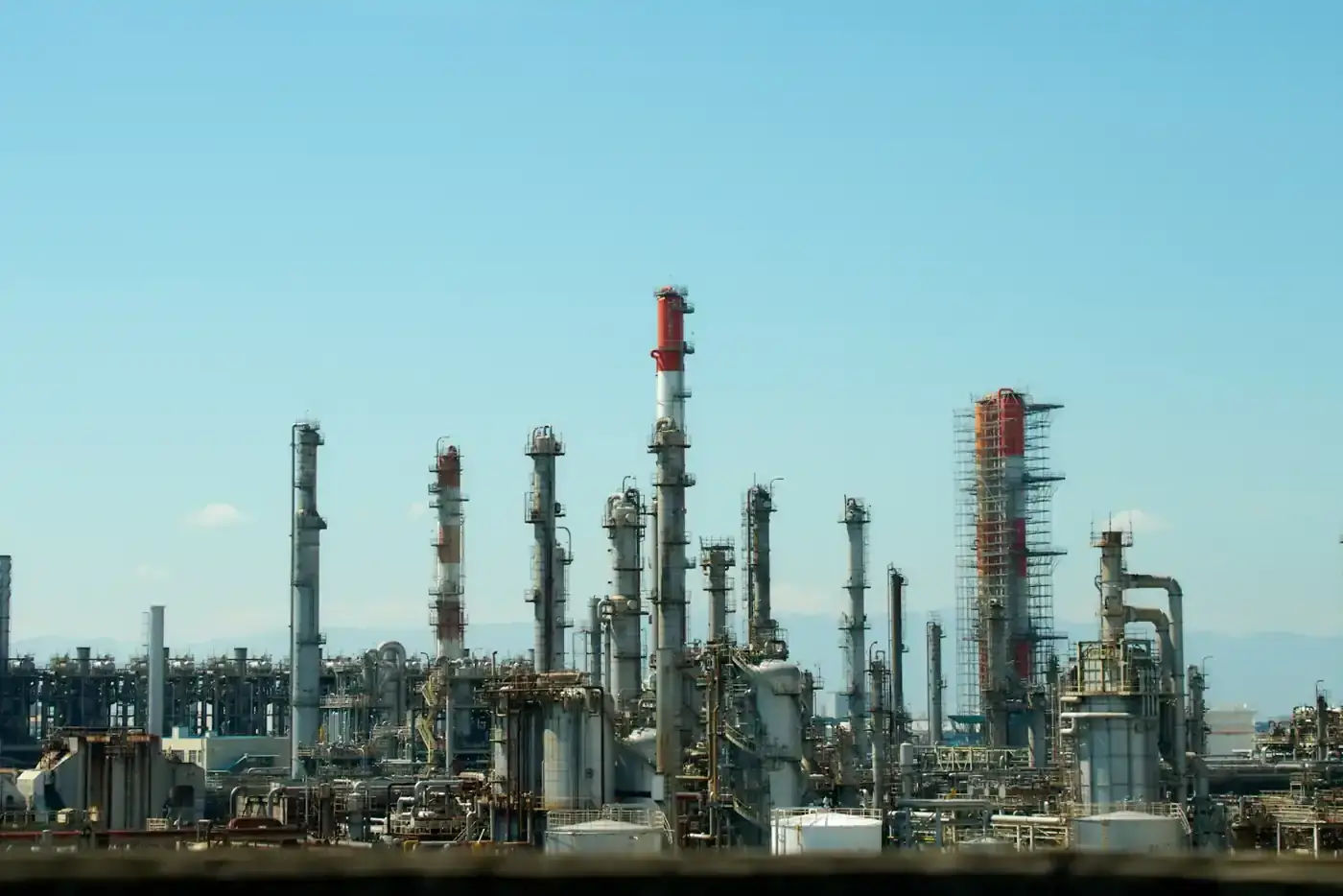
Downstream · Modular refining
Refine as close as possible to the market: a modular, redeployable mini-refinery — 500–2,000 b/d trains on skids, maintenance by module exchange. The refining industry, at Chad’s scale.
Refining & Distribution · Our trump card
Our trump card for reaching our objectives: a refinery that is modern, modular, removable and small-scale, designed in Chad for our realities. Standardised 500 to 2,000 b/d trains, prefabricated and skid-mounted, 100% catalogue parts. Where a mega-refinery is rigid and out of reach, our unit deploys, redeploys and upgrades crude as close as possible to the satellite blocks — a mobile asset, never stranded. (ambition · company in formation)
Standardised trains assembled in the factory, then hooked up on site like building blocks.
Challenge — A mega-refinery is rigid, oversized and financially out of reach.
Integrated answer — Standardised 500–2,000 b/d trains, 100% catalogue parts, capacity added module by module.
Targeted gainInvestment spread out and pegged to real demand
Skid-mounted: the unit is transported, set down and lifted again without heavy civil works.
Challenge — Heavy civil works tie up capital and freeze the site.
Integrated answer — A skid-mounted unit, transportable by road, light foundations.
Targeted gainDeployment without a permanent worksite — capital never frozen
Refining follows the crude: the unit moves to the satellite blocks and the markets.
Challenge — A fixed refinery cannot follow production as it evolves.
Integrated answer — The unit moves to the satellite blocks and the markets as demand dictates.
Targeted gainA mobile asset earning continuously, never stuck
Deliberately small: upgrade crude locally rather than export it all.
Challenge — Exporting all the crude and importing all the fuel destroys value.
Integrated answer — Small-scale local refining, as close as possible to the well.
Targeted gainFuels produced in-country · reduced import dependence
Availability first: a module is replaced instead of stopping the plant.
Challenge — A plant shutdown for maintenance costs weeks of production.
Integrated answer — Module replacement (target < 24 h) drawn from a pooled catalogue inventory.
Targeted gainAvailability maximised · downtime minimal
Digital supervision and HSE by design, frugal site power.
Challenge — Manual operation and carbon-heavy power weigh on safety and cost.
Integrated answer — Remote digital supervision, HSE by design, frugal site power.
Targeted gainSafety prioritised · operating cost controlled
Everything presented here is a target or ambition of a company in formation — not assets in operation.
Continue in Refining & Distribution
The concept at a glance
A modular mini-refinery is not a large refinery in miniature: it is a short chain, sized for local demand, designed to be assembled, operated — and moved. Here, at a single glance, is how Doba crude becomes fuels, gas and bitumen.
↔ Scroll the diagram horizontally.
Where a mega-refinery demands colossal capital in one go, the modular model invests train by train: you pay for capacity at the pace demand justifies. No oversizing, no asset frozen in concrete.
A proven process, few units, 100% catalogue parts: maintenance is done by swapping a module (target < 24 h) rather than a lengthy shutdown. Frugality is in the architecture — not in the critical steels, anti-corrosion for Doba’s acidic crude.
Crude arrives from nearby satellite blocks: a short chain, less transport, value captured close to the well. When a field declines, the unit lifts off and redeploys to the next.
Every barrel refined on site is a litre that does not leave for export only to return imported at a premium. The model tackles Chad’s paradox head-on: producing oil yet enduring expensive fuels.
Schematic of principle — the units, cuts and specifications illustrate the target model of a company in formation; they do not describe an asset in operation.
A modular mini-refinery is not a large refinery in miniature: it is a short chain, sized for local demand, designed to be assembled, operated — and moved. Here is its journey.
Crude arrives from the nearby field, is metered, settled and stripped of its water and sediments: clean crude protects the whole chain downstream.
Brought up to temperature, the crude rises in the atmospheric column: each cut — gas, gasolines, kerosene, diesel, residue — separates by boiling point.
Each cut is stabilised, blended and checked in the laboratory against national specifications: an off-spec product never leaves the site.
The column bottoms are not waste: heavy fuel oil for industry and power plants, bitumen base for roads — every fraction finds its use.
Dedicated tanks per product, custody metering at loading, batch traceability: the mini-refinery supplies the Refining & Distribution depots, with the numbers to prove it.
When local demand shifts or a field declines, the unit is dismantled and rebuilt elsewhere: capital follows the need — that is the whole point of “movable”.
The Mobile Station™ philosophy applied to refining: standardised 500–2,000 b/d trains, assembled into three configurations depending on the territory to serve — and expandable train by train, without shutting the unit down. (target range · company in formation)
The unit that opens a basin
1 train · 500 b/d · containerisable
The regional backbone
2 trains · 1,000–2,000 b/d
The compact complex
3+ trains · up to 6,000 b/d
Each train swaps out like a Mobile Station™ module: maintenance by standard exchange, capital that follows demand. Cumulative target in the order of 40 kb/d by 2030 — see the project (in French) →
Ultra-modern by design
No legacy systems to drag along: every unit ships from day one with the technology layer that large complexes bolt on afterwards.
A living digital replica of the unit: test a cut, a feed, a maintenance operation in the virtual world before touching the real one. The TchadiTech backbone →
Machine-learning optimisation adjusts diesel/gasoline/kerosene yields to local demand and crude profile — each barrel earns more, with no new capex.
Continuous supervision, predictive maintenance and inspection robotics (tanks, flares, lines): more monitoring, less human exposure.
Process gas powers the unit (heat, electricity), hybridised with on-site solar — a refinery that produces energy without wasting it. GreenTech →
Process water treated and reused, discharges controlled: in a water-stressed Chad, the refinery gives back the water it borrows.
HAZOP/LOPA studies from the design stage, safety-instrumented systems (SIS) and tested emergency shutdowns (ESD) — big-complex standards at skid scale.
The key to the vision
Refining locally, as close to the need as possible, is what makes everything else work: the regulated ARSAT price held everywhere, shortages cushioned by the depots, and the everyday products — diesel, gasoline, LPG, bitumen, Jet A-1 — made from Chadian crude rather than imported from 1,700 km away. The mini-refinery feeds the hub stations and Mobile Stations™, supplies the product range, secures the distribution cascade — and prepares the petrochemical stage. It is the link that turns a slogan into a network. Discuss the model →
Quality · Proof to the litre
Every cut targets named specifications — harmonised African references (AFRI/ARSO) and EN 228 / EN 590 equivalents in sight, target sulphur content per product. Every shipped batch leaves with its laboratory certificate of analysis, retained witness samples — the same chain of proof as the corridor’s custody.
Managed flare and systematic hot-work permits, containment under every piece of equipment, and effluents looped into the company’s water management — the mini-refinery applies to finished products the Water-to-Value™ discipline born in the field.
No cracking, no hydrotreating: the first tier is an atmospheric distillation, deliberately simple. Products that require those units remain imported at this stage — stated plainly, as for multimodal. Further tiers will come when volumes justify them. (ambition · company in formation)
Brightness