Midstream · Solutions & products
Sites & infrastructure
The map of the infrastructure that secures supply: EnerTchad’s depots, distributed reserve and storage assets across the country.
Our place in Chad’s infrastructure.
The sector landscape — mature fields, export corridor, national refinery and ocean terminal — is described in detail in the Atlas of the Chadian oil sector (in French). EnerTchad does not operate them itself: it positions itself there as an operator and technical partner, and deploys its own target assets, from gas-power to the pump.
See the sector landscape in the Atlas →Station-hub network
A three-tier distribution network: three hub-depots (N’Djamena, Moundou, Abéché) wholesaling to their satellite stations, flagship stations in the dense south-west and the oil basin, and catchment stations in the landlocked areas. EnerTchad deploys its own brand there: fuels, LPG and lubricants.
Sédigui gas field
A strategic gas resource feeding our electricity business (gas-to-power) — the gas-power link.
Mobilising the export corridor.
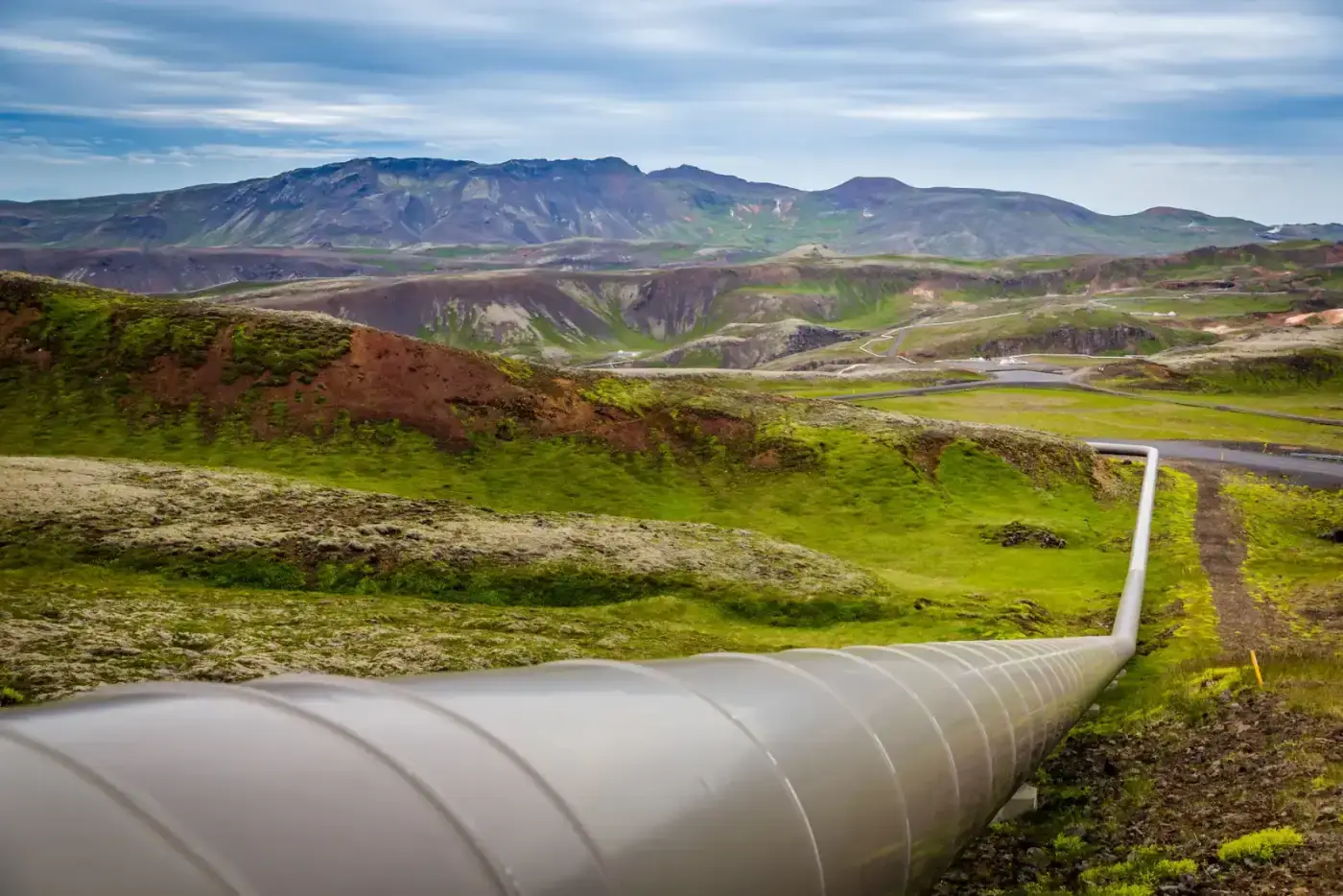
Chadian crude reaches the Atlantic through the national export corridor — operated by third parties. EnerTchad does not operate it itself: it positions itself there as an operator and technical partner, and orchestrates the flows it ships. The detail of the sector’s infrastructure and operators (TOTCO/COTCO, SHT, FSO, fiscal metering) is presented in the Atlas of the Chadian oil sector (in French).
See the corridor in the Atlas →Pipeline vs tanker truck
Real-time supervision and the corridor’s infrastructure data belong to the sector — see the Atlas (in French).
Modular & movable refineries, right next to the resource.
Not every field justifies a pipeline tie-in. Our modular, skid-mounted, prefabricated and transportable refining units process on site the crude of satellite basins, isolated blocks and marginal fields — converting otherwise uneconomic resources into petroleum products marketable locally. Refining strictly belongs to the Refining & Distribution pole: these mobile units appear in the Transport & Storage chapter because they deploy like infrastructure of the interior, right next to the unconnected fields.
Containerised units built in the factory, delivered by road and assembled on site in a few weeks.
From a few hundred to several thousand b/d: modules are added as the field develops.
Once a field is depleted, the unit is dismantled and redeployed on a new site — a mobile asset, not a stranded one.
Diesel, kerosene and fuel oil refined locally: less transport, supply for the landlocked regions.
Cheaper to build, simpler to maintain.
The Mobile Station™ philosophy applied to refining: standardise, fractionalise, swap — rather than building industrial cathedrals.
- ▸Standardised trains of 500–2,000 b/d: one design, replicated — each copy costs less than the last
- ▸Factory prefabrication, zero heavy civil works — skids set on a slab, hooked up in weeks
- ▸Catalogue parts (off-the-shelf pumps, valves, exchangers) — no exotic component
- ▸Metallurgy exception: Doba crude is acidic (high acid number) — wetted parts are in steels resistant to naphthenic corrosion. Frugality applies to the architecture, not to the critical materials
- ▸Self-consumed energy (site gas) — reduced opex, zero logistics diesel
- ▸Swap < 24 h: the failed module is exchanged for a spare, then repaired at the central N’Djamena workshop — as in aviation
- ▸A common parts stock for the whole fleet: one store, one reference per component
- ▸IoT sensors + SCADA: predictive maintenance — intervene before the breakdown, not after
- ▸Chadian, Tchaditude-trained operators and maintainers — site autonomy, no captive expatriate
Each train carries its own sensors (temperature, pressure, flow, vibration) and a layer of artificial intelligence that optimises costs in real time — tuning yields to the incoming crude and the demand — and watches over operational integrity: drift caught before the breakdown, maintenance predictive rather than endured, shutdowns scheduled rather than improvised.
The satellite-block lever: coupled with our consortium strategy on the 38 free blocks, modular refining makes fields deemed too small or too remote for the majors economically viable — a decisive advantage for monetising the Chadian licence map.
When the pipeline doesn’t pay, the road takes over.
Not every field justifies a pipeline tie-in. For isolated or low-volume basins and blocks, EnerTchad plans to evacuate crude with a fleet of purpose-built, latest-generation tanker trucks — flexible logistics that make otherwise stranded fields workable.
Aluminium or stainless tankers designed for crude and refined products, compliant with international hydrocarbon-transport standards.
Real-time GPS tracking, overfill valves, safety valves and drivers trained in dangerous-goods transport.
Delivery to the Djermaya refinery, the depots or the pipeline tie-in points, without heavy infrastructure investment.
A latest-generation fleet with reduced consumption and emissions, optimised by route planning to limit empty runs.
Real-time transport control.
Leak detection by negative pressure wave, annual in-line inspection (ILI / smart pigging), impressed-current cathodic protection, 85 piezometric stations along the corridor. ML-driven predictive maintenance: micro-leaks caught 3 to 5 days before rupture.
Simulated values for demonstration, calibrated on the export corridor’s public capacity (225 kb/d) and the utilisation rate used across the site (~90 kb/d) — no real flow.
Specialised tanker trucks, safe by design.
Where the pipeline doesn’t go, the last kilometre travels by road: a target fleet of tanker trucks designed first for the safety and integrity of hydrocarbon transport. (target fleet · company in formation)
Multi-compartment aluminium/stainless tankers for fuels, LPG and bitumen — dangerous-goods (ADR) compliance targeted.
Bottom valves, overfill protection, mandatory earthing, relief and check valves — strict HSE procedures at every operation.
Remote shutdown device, on-board extinguishers, emergency plan and drills — the risk handled before the first drop.
Regulatory checks, tank pressure tests, non-destructive testing and a logbook — integrity traced end to end.
Real-time GPS tracking, corridor geofencing, level and temperature sensors — total visibility on every cargo.
ADP/ADR-trained drivers, PPE, journey management (the road is the first risk in Chad) and stop-work authority given to everyone.
Continue in Transport & Storage
How a site enters service: five milestones
A depot or terminal is not improvised: from picking the land to the first receipt, every site clears the same milestones — and only moves to the next once the last one is solid.
Pick the land
Local demand, road access, flood risk, distance to dwellings: the best site is a documented trade-off, not a land opportunity.
Design & permit
Hazard studies, bunding and distance standards, permits and consultations: compliance is built on the drawing board, not in catch-up.
Build under control
Local firms supervised, quality checks at every critical step — welds, sealing, electrical earthing: what gets buried must be beyond reproach before it is.
Commission
Tank pressure tests, meter calibration, operator training, an initial emergency drill: the site receives its first litre only after its full demonstration.
Operate & review
Rounds, telemetry, periodic safety reviews and material balances: a site in service remains a site under watch — and every incident avoided elsewhere enriches its standards.
To go further