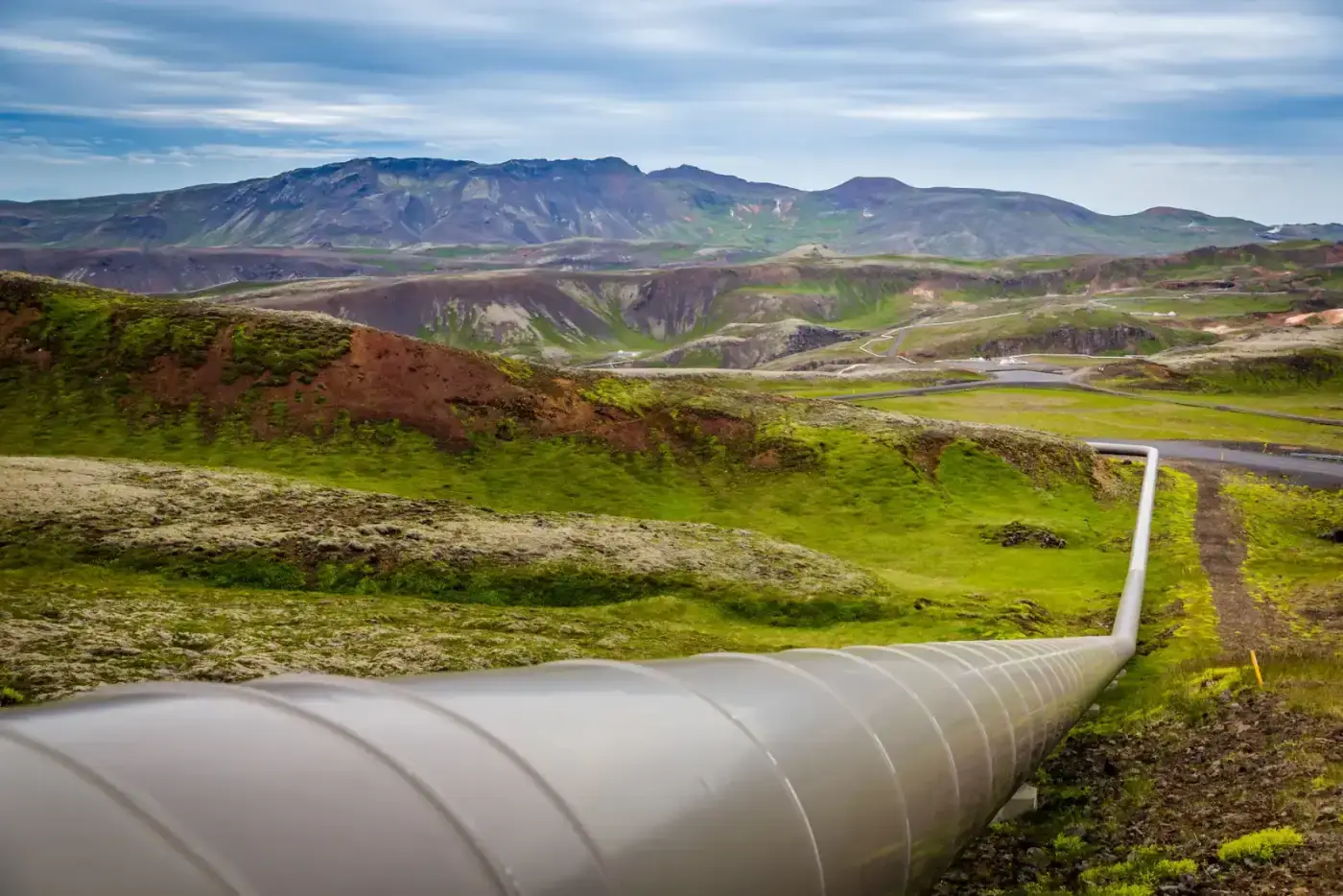
Between the well and the pump, the Transport & Storage moves the molecule and guarantees supply. EnerTchad aims for an integrated, resilient logistics link: mobilise the export corridor, build a distributed reserve, secure every kilometre — the backbone of Chad’s energy autonomy.
Pillar 01
Mobilise the export corridor
The national export corridor is the artery that links Chadian crude to the ocean. EnerTchad aims to optimise its use — regulated access, lifting schedules, transit reliability — so that every barrel produced finds its way to market without interruption.
Pillar 02
Build the distributed strategic reserve
Rather than one vulnerable central depot, a mesh of depots spread across the country: each covers its region, and together they form a resilient national reserve. The target — several weeks of coverage — protects the country against import disruptions.
Pillar 03
Guarantee integrity & safety
A pipeline and remote sites demand continuous monitoring: pipe integrity, leak detection, preventive maintenance, HSE protection. Data and real-time control turn safety from a constraint into an operational advantage.
Pillar 04
Orchestrate multimodal logistics
Pipeline for the big volumes, road for the last kilometre: EnerTchad aims to combine the modes to move the molecule to the regional depots and on to the stations, including where infrastructure is missing. Fewer assets tied up, more flexibility.
Corridornational export · to be mobilised
Reservedistributed · multi-week target
Multimodalpipeline + road · last km
24/7integrity & real-time control
The model we are adapting
Crude by truck: making the barrel roll before the pipe.
Not every Chadian field is connected to a pipeline — and many never will be. The tanker truck is the link that unlocks those barrels: it gathers crude at the wellhead, carries it to our modular mini-refineries and regional depots — for supplying the interior, crude exports still flowing through the Komé hub and the Chad-Cameroon pipeline (TOTCO-COTCO) — and turns an isolated field into a flow of value without waiting years for civil works. EnerTchad aims to industrialise this road transport of crude — reliable, safe, traceable — as the first logistics building block from Exploration & Production to Refining & Distribution.
Diagram of the target hub-and-spoke network — gathering at the fields, central hub, regional depots & mini-refineries. Indicative locations · company in formation.
Gathering at the wellhead
Removable loading skids on unconnected sites. Crude leaves the field from the very first barrel produced — no pipeline tie-in required.
Insulated tankers
Doba crude is waxy, with a high pour point: it sets when cold. Insulated, heated tankers targeted, so it stays pumpable from well to depot.
Hub-and-spoke network
Shuttles from the wells to regional depots and the interior’s mini-refineries. Loaded returns possible (finished products) — every trip carries value both ways.
Telemetry & HSE
GPS, convoy geofencing, real-time volume & temperature tracking, anti-loss gauging. Road safety and barrel traceability run on data (TchadiTech).
Deferred capexthe road before the pipeline
Per barrel·kmtarget pricing model
Modulara fleet that follows production
Fast deploymentweeks, not years
Target logistics model · company in formation. Volumes, radii and fleet sizes will be calibrated as fields come on line.
Doctrine 01 · Resilience
The distributed reserve: turning a geographic weakness into strategic strength.
Chad is landlocked. Its fuel travels thousands of kilometres before reaching the pump, and the slightest break in the import chain — a closed border, a road cut in the rainy season, regional tension — can dry out entire regions. A single central depot, however large, remains a point of failure: if it goes down, the whole country stops.
EnerTchad flips the logic. Rather than one vulnerable point, the midstream link aims for a mesh of regional depots: each covers its zone, each backs up the others. Together these nodes form a distributed national reserve — physical insurance against supply shocks, sized to cover several weeks of consumption even when imports stop. Resilience stops being a cost: it becomes a strategic advantage.
Doctrine 02 · Corridor
The export corridor, artery of energy autonomy.
Chadian crude reaches the ocean along a single axis of more than a thousand kilometres, from the producing basin to the ocean terminal. That artery conditions the country’s entire oil economy: its reliability decides how much value Chad actually captures on each barrel produced. An irregular transit means production stuck on the ground and value lost.
The midstream link’s ambition is to maximise its use and predictability: fine-grained lifting schedules, regulated access, upstream-downstream coordination so that every barrel produced finds its way without waiting. The better the corridor is orchestrated, the easier the whole chain breathes — and the more value stays in Chad rather than dissolving into logistics costs and transit penalties.
Doctrine 03 · Integrity
Integrity through data, not luck.
A pipeline, depots and remote sites are not secured by occasional checks: they are managed. EnerTchad aims for integrity management built on real-time data — pressure and flow sensors, early anomaly detection, predictive rather than curative maintenance. A leak caught early costs a thousand times less than a leak endured, in money as in the environment.
The same data feeds HSE safety and the protection of the facilities: knowing the state of every link at every moment is how you protect people, the environment and the national asset. The discipline of measurement turns a regulatory constraint into a lasting operational advantage.
Doctrine 04 · Last kilometre
The last kilometre, where autonomy becomes real.
Moving big volumes by pipeline is efficient; reaching the last community rarely is. Yet that is where — on the last kilometre — access to energy is won or lost. EnerTchad aims for multimodal logistics that combines the modes — the pipeline for the big flows, the road and regional depots for fine-grained delivery — to serve the areas imports leave behind.
By anchoring transport to a network of distributed depots rather than a heavy idle fleet, the model stays light on capital and rich in flexibility: move the molecule the shortest way, store it as close as possible, deliver it just right. The midstream link thus becomes the invisible hyphen between the Chadian well and the citizen’s purchasing power.
Mesh · Target depots
A network designed so no region is the end of the world.
The distributed reserve is not an abstract idea: it unfolds as a string of regional depots, each positioned to cover a consumption basin and back up its neighbours. Here are the target nodes that structure EnerTchad’s logistics ambition — a progressive mesh, calibrated to the country’s real geography.
N’Djamena · Central hub
The heart of national demand and the redistribution node. The hub that regulates flows across the whole country and absorbs the capital’s consumption peaks.
Moundou · South
Closest to the producing basins and the farm belt. Secures supply for the productive South and shortens the last kilometre to the farms.
Sarh · South-East
Serves the South-East and the cross-border axis to the region. A foothold for areas that long-distance logistics serves poorly.
Abéché · East
Opens up the East and secures the border areas. Where imports run out of breath, a regional depot changes access to energy for hundreds of thousands of people.
Faya-Largeau · North
Serving the Saharan North — the ultimate test of supply autonomy. Store as close as possible so distance stops being fate.
Mesh · network effect
Each depot covers its zone and supports the others: a local incident no longer switches off a region. Together they form the distributed national reserve — resilient by design.
Economics · Cost-to-serve
Pipeline, road, storage: three levers, one equation.
The midstream link does not choose between modes: it composes them. The pipeline excels at big volumes at the lowest unit cost, but it is rigid and serves only its entry points. The road is dearer per barrel, but it is what reaches the last community and absorbs the unexpected. Storage, finally, decouples production from consumption: it cushions shocks, smooths prices and lets you buy at the right time.
The art of the link is to minimise the end-to-end cost-to-serve — not the cost of one isolated segment. Move the molecule the shortest way by pipeline, store it as close as possible in a regional depot, only bring out the road for the last kilometre: that orchestration is what preserves margin along the chain and, in the end, protects the price the Chadian pays at the pump. Every franc saved in logistics is a franc returned to purchasing power or reinvested in the country.
Comparing the modes · the logistics equation
Pipeline
Volumevery high
Cost / barrel·kmthe lowest
Flexibilitylow
Lead timelong
The backbone for big volumes, from field to depot — a long-term target.
Tanker truck
Volumefractional
Cost / barrel·kmhigher
Flexibilitymaximum
Lead timeimmediate
The last kilometre and opening up the country — it makes the barrel roll before the pipe.
Multimodal
Volumeoptimised
Cost-to-serveminimised
Flexibilitycomposed
Lead timestaged
The orchestration of the three levers — margin preserved, price protected.
Indicative sector characteristics · EnerTchad’s logistics architecture is a target (company in formation).
Integrated chain · Synergies
The hyphen that makes integration real.
An integrated oil company is only as good as the fluidity between its links. The Transport & Storage is that hyphen: it receives the mature fields’ production from the Exploration & Production and schedules it; it feeds the Refining & Distribution with steady flows to the mini-refineries and the station network. Without it, the Exploration & Production produces into a void and the Refining & Distribution runs dry.
The advantage of integration plays out in shared planning and common data: one horizon, from well to pump, where every logistics decision accounts for production upstream and demand downstream. That whole-chain steering — impossible for fragmented players — is what turns a succession of steps into a coherent machine, and keeps value in Chad at every link rather than ceding it to outside middlemen.
Trajectory · 3 horizons
A ramp-up in controlled stages.
H1
Priming. Mobilise the export corridor, secure the supply flows and establish the central hub — make it reliable before extending it.
H2
Roll-out. Establish the first regional depots, reach an initial multi-week coverage and hook up real-time integrity data.
H3
Maturity. A nationwide distributed reserve, full multimodal logistics and data-driven integrity across the whole link.
Indicative horizons — targets of a company in formation, sequenced by the priority of reliability before scale.
The chain of custody, from weighbridge to offloading.
On a 1,700 km corridor, trust is not declared — it is proven, litre by litre, document by document. Three protocols carry it.
Custody & loss prevention
Numbered seals fitted at loading and checked at offloading, weighbridge weighing at departure and arrival, joint gauging with the client, contractual shrinkage tolerance displayed — and loaded/delivered reconciliation through telematics. Losses are not a fate of the corridor: they are a tracked indicator.
Journey management
Every trip leaves with a validated journey plan: capped driving hours, fatigue management, secured rest and parking points, night sections prohibited, GPS tracking and check-ins at waypoints. Road HSE gets the same rigour as well HSE — same foundation, same audits.
The Chadian calendar
Chadian logistics is planned around the rainy season: stocks pre-positioned before the rains, the distributed reserve rotated during, replenishment after. That is the operational justification of the distributed reserve: regional depots carry the country when the road no longer can.
And multimodal, plainly said: today the road dominates the corridor and the pipeline carries large crude volumes; the trans-Cameroonian railway is an option under study as volumes grow. (targeted protocols · company in formation)
Every barrel moved and every litre stored follows the same monitored path — and every step has its indicator: availability, in-line losses, days of reserve.
Step 1
Lifting at the field
Metering at the entry point, scheduling of pipeline or truck liftings by volume and season.
Step 2
Monitored transport
Pipeline under SCADA supervision, convoys under GPS telematics: position, pressure and temperature known continuously.
Step 3
Transit & borders
Transit files prepared in advance, CEMAC compliance: the border crossing is won at the desk, not at the checkpoint.
Step 4
Receipt at the terminal
Witnessed metrological metering, batch quality control, reconciliation of in-line losses.
Step 5
Storage & rotation
Tank allocation, first-in-first-out rotation, progressive build-up of the strategic reserve.
Step 6
Hand-over
Delivery to distribution depots and industrial customers: the link hands over to the Refining & Distribution, numbers in hand.