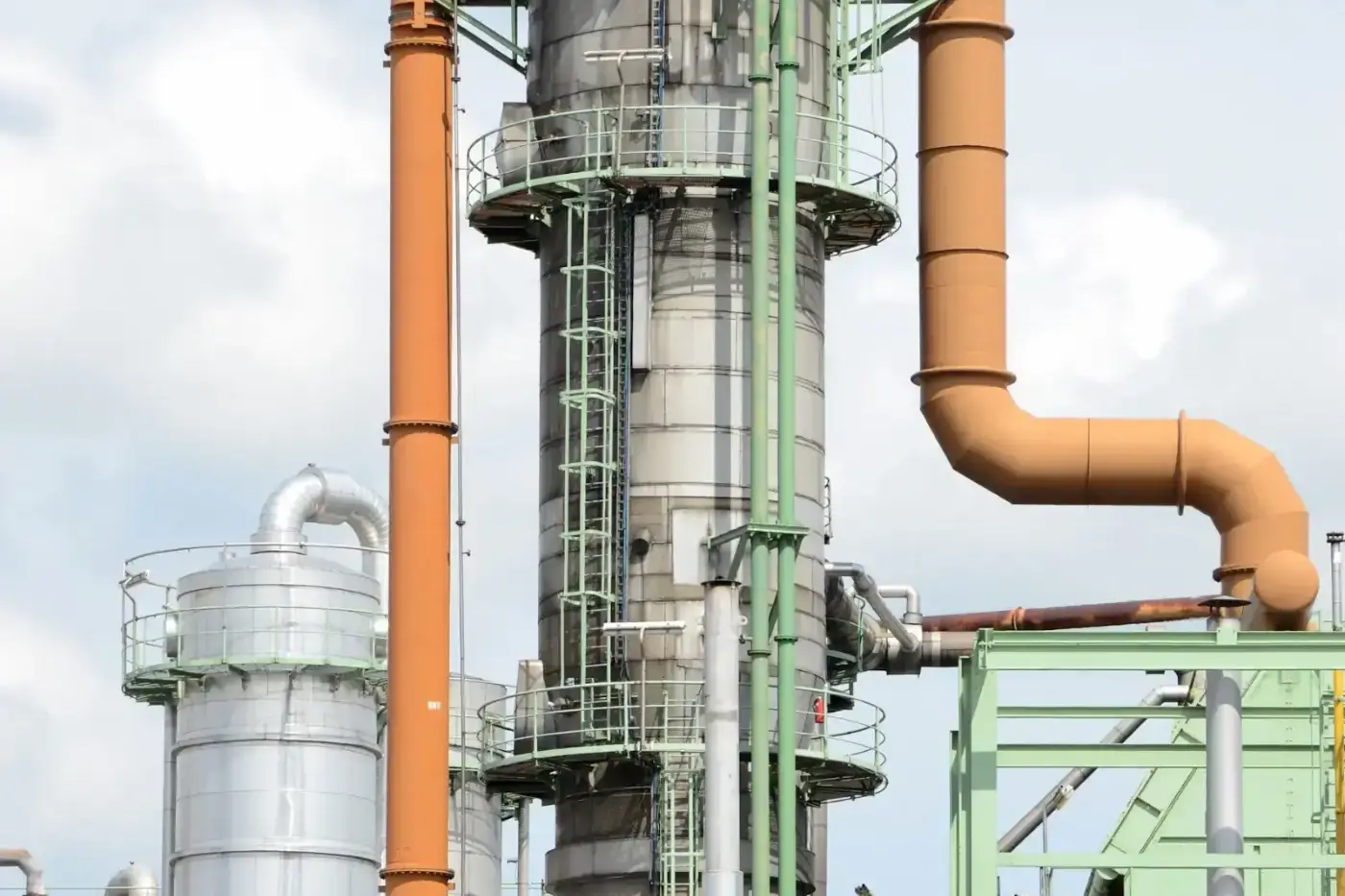
Petrochemicals · Oilfield chemistry
Chemistry for the barrel
The chemistry that makes crude flow: EOR chemistry on local feedstocks (ASP — natron, neem), flow treatment and protection to optimise recovery.
Browse this page · 4 themes
Beyond products, the chemistry that makes crude flow.
Petrochemistry transforms the molecule on the way out; oilfield chemistry acts upstream, in the well and the pipe. The Petrochemicals pole aims to give Chad both faces of the same value chain — from EOR inputs to production fluids.
EOR chemistry · ASP
The heart of “oilfield chemistry”: the alkali-surfactant-polymer (ASP) agents that mobilise residual crude. Alkali on local natron (Na₂CO₃), biopolymers and surfactants — the inputs that make EOR work best, and that we want to produce in Chad (Exploration & Production link).
Treat & protect the flow
Demulsifiers, corrosion, scale and paraffin inhibitors, biocides: the chemistry that separates water from crude, protects wells and pipes and keeps production reliable around the clock.
Drill & complete
Muds and additives (viscosifiers, weighting agents, fluid-loss agents) to drill and complete safely — a recurring need of every E&P operator, to be supplied locally rather than imported.
Water & co-products
Flocculants, clarifiers and produced-water treatment agents; valorisation of salts and chemical co-products — chemistry serving the water cycle (GreenTech link).
A phased value chain, from most mature to most capital-intensive.
- Household LPG — substituting wood fuel
- Gas-based ammonia — the base of nitrogen fertilisers
- EOR inputs — ASP on local resources
- Methanol & derivatives (C1)
- Urea & NPK · refinery sulphur
- Bitumens & lubricants — heavy crude
- Production chemistry & fluids
- Polymers — PP, then PE & PVC
- Olefins / aromatics (BTX)
- Conditional on the gas ramp-up
From Chadian soil to the heart of the reservoir.
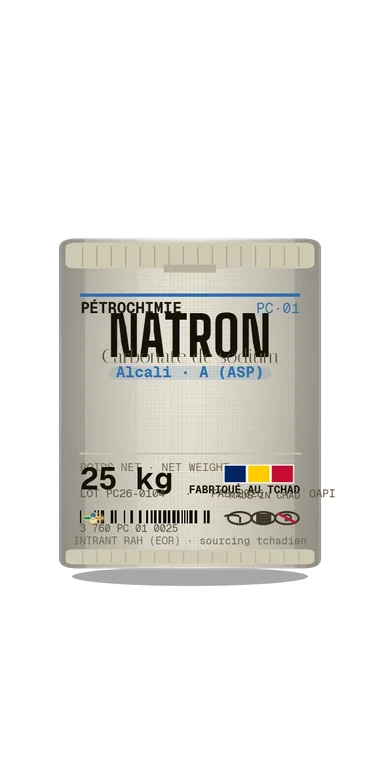
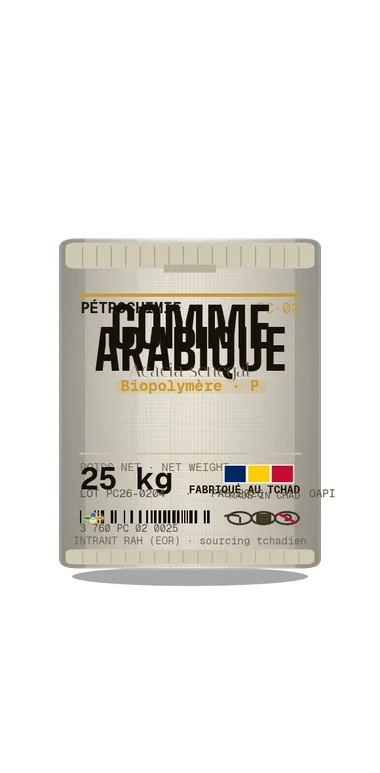
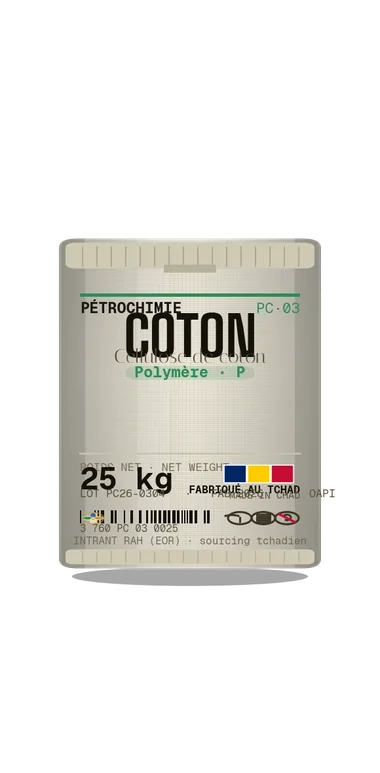
Enhanced recovery (ASP, MEOR) consumes alkalis, surfactants and polymers — imported today. Chad holds most of these resources in its subsoil and its crops. Our ambition: transform them on the spot into branded feedstocks, packed in multi-format bags, for a double outlet — the farmer’s field and the oil well.
Reservoir side · Exploration & Production pole
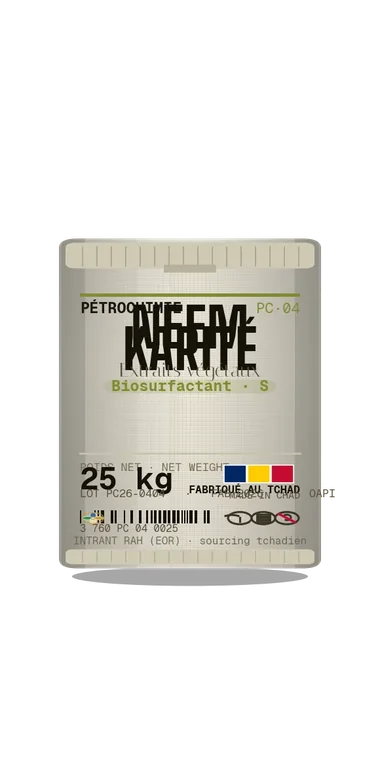
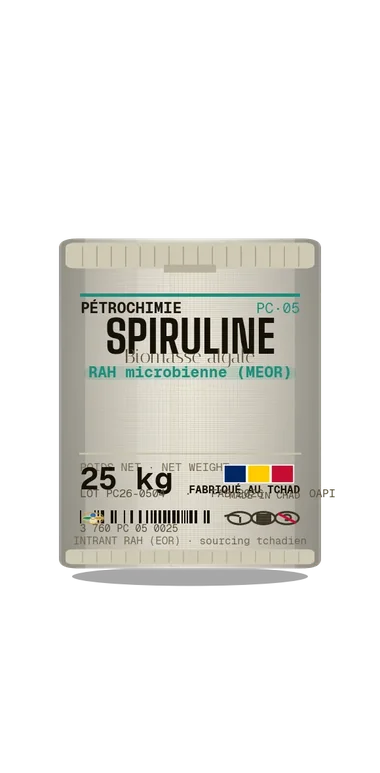
The detailed formulation of these feedstocks — natron as the alkali, gum arabic and cellulose as polymers, neem & shea as biosurfactants, spirulina for MEOR — is decoded where it acts: on the Exploration & Production pole’s Enhanced recovery page.
The six feedstocks, read as an EOR formulation →A feedstock brand, from farm bag to big-bag.
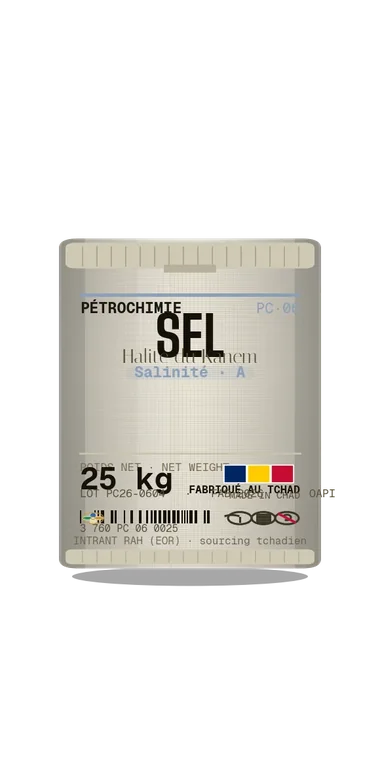
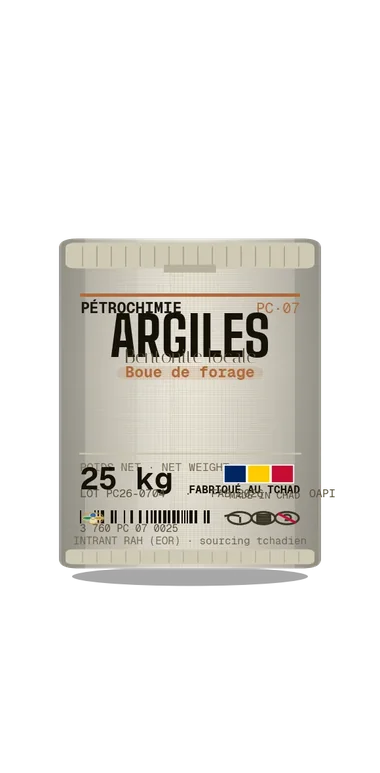
Our own label, lot traceability, the Chadian flag: our eight feedstocks in industrial packaging — from the 25 kg local bag to the 1000 kg big-bag. (designs · horizon 2030 targets)
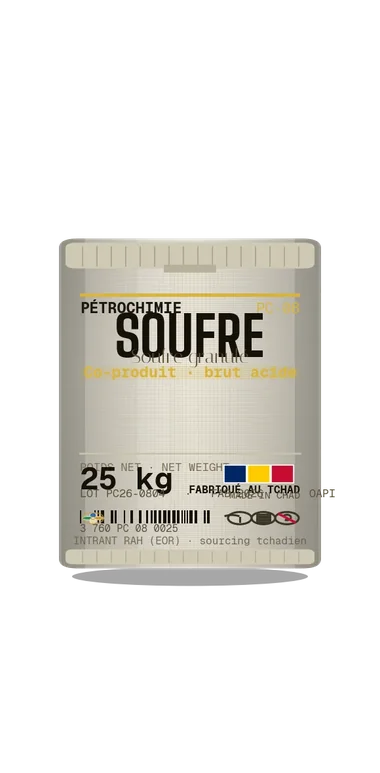
Where Chad draws its feedstocks.
Four broad regions concentrate the resources: the Lake and Kanem (minerals & algae), the Sahelian belt (gum arabic), the Sudanian South (crops) and the oil basins (clays, sulphur).
The mineral & algal source — alkalis and biomass at the heart of ASP.
The acacia belt — a biopolymer Chad already exports to the world.
Doba & Bongor — drilling clays; sulphur, a modest refining co-product.
The crop basket — cellulose and biosurfactants from the South’s cultures.
Sourcing in Chad keeps four regions alive.
Every feedstock bought at home feeds a local chain: gum pickers in the Sahel, salt workers in Kanem, cotton growers in the South, spirulina cooperatives at the Lake. The Petrochemicals pole does not just produce — it structures a new, stable, well-paying demand for resources that have been under-valued until now.
Product partnerships · targeted quality
Quality through partnership
Recovery chemistry — surfactants, polymers and ASP — will be co-developed with specialist partners and qualified on local feedstocks, to make crude flow reliably.
Targeted partnerships · company in formation — not signed agreements at this stage.
Continue in Petrochemicals